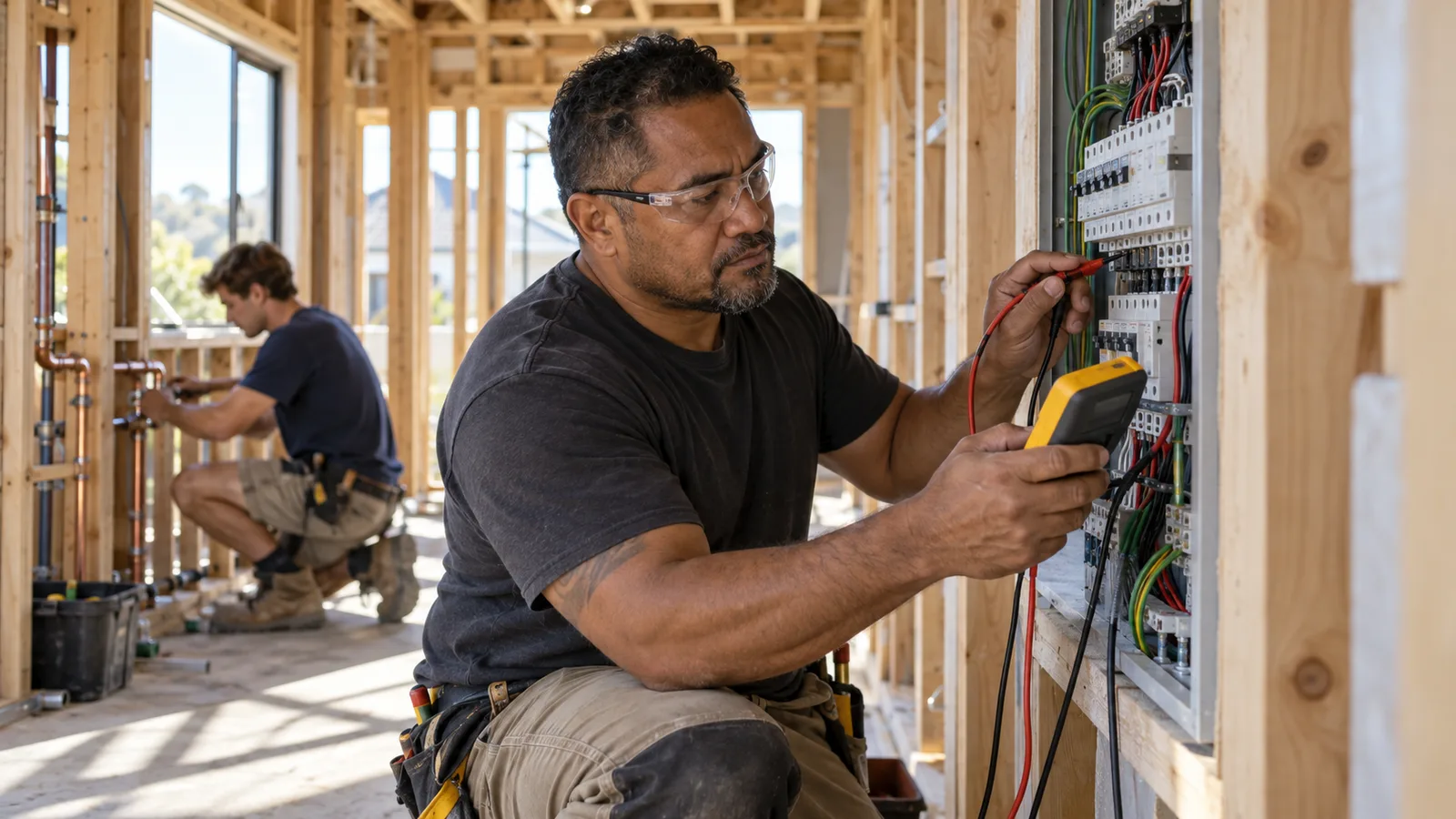
An electrician skills assessment in Australia is done by Trades Recognition Australia (TRA), and for permanent migration it has to go through the Offshore Skills Assessment Program (OSAP), whatever passport you hold. A pass gives you an Offshore Technical Skills Record (OTSR), not a licence: it is the first step on a licensing path that runs through gap training, supervised work and the Certificate III in Electrotechnology Electrician. This guide explains each stage, what it costs and how to prepare your evidence so years of wiring work count.
Two electrician codes, one assessing authority
Home Affairs' combined occupation list has two electrician occupations, and TRA assesses both. Electrician (General) is ANZSCO 341111 and Electrician (Special Class) is ANZSCO 341112. Both sit on the MLTSSL and the CSOL.
Pick the code that matches the work you actually did, because your employer statements and photos will be compared with that occupation. You can check both codes on the Home Affairs skilled occupation list.
Why OSAP is not optional for electricians
For most trades, OSAP applies only to certain passport countries. Electricians are different. TRA lists Electrician (General), Electrician (Special Class), Plumber (General) and Air-conditioning and Refrigeration Mechanic as licensed occupations where OSAP is compulsory for permanent migration, and it says applicants from all countries must have an OSAP assessment unless they are applying for a 482 or 485 visa.
The other TRA programs are closed to you. The Migration Skills Assessment, a documents-only check used by many other trades, cannot be used for electricians. The Job Ready Program for Australian VET graduates also excludes electricians. Our guide to the five TRA programs and who each one is for shows where every route fits.
Applying for a 482 visa instead
If an employer is sponsoring you for a Skills in Demand subclass 482 visa, the program is the Temporary Skills Shortage (TSS) Skills Assessment, and TRA says it is compulsory for 482 applicants who are Electrician (General) or Electrician (Special Class). TRA says the RTO emails the TSS outcome approximately 9 weeks after you submit complete documentary evidence. The fees match OSAP: up to $5,320 for Pathway 1 and $2,020 for Pathway 2.
Pathway 1 or Pathway 2
OSAP has two pathways. Pathway 1 is for applicants without a relevant Australian VET qualification, which covers most electricians trained overseas. Pathway 2 is for applicants who already hold a relevant Australian VET qualification or a current identified Australian occupational licence without restrictions.
Pathway 1 also sets a work history bar. The OSAP guidelines (July 2026) ask for 6 years of full-time paid employment in a licensed trade if you had no formal training, or 4 years if you had formal training such as an apprenticeship or trade course.
| OSAP stage | Pathway 1 (no Australian qualification) | Pathway 2 (Australian qualification or licence) |
|---|---|---|
| Documentary evidence | $1,120 | $1,120 |
| Technical interview | $2,000 | $900 |
| Practical assessment | $2,200 (if required) | Not part of Pathway 2 |
| Total | Up to $5,320 | $2,020 |
All fees are in Australian dollars and come from TRA's OSAP program page. TRA says applications are typically processed within 15 weeks of submitting complete documentary evidence, as a guide only, so plan your visa timeline around that.
What the assessor wants to see
OSAP has two phases. First comes a Documentary Evidence Assessment. Then comes a Technical Skills Assessment, which includes a technical interview and, for licensed occupations like yours, a practical assessment.
Documents that prove the job
TRA asks for employer statements on business letterhead showing exact employment dates, hours, your job title and detailed tasks. You also need pay evidence, such as three payslips that name both you and your employer. Documents that are not in English need English translations.
Vague statements are the most common weak point. "Electrician, 2015 to 2022" tells the assessor almost nothing. Listing the installations you wired, the boards you fitted and the testing you signed off gives them something to match. Our evidence checklist for a TRA skills assessment goes through each document in detail.
Photos and videos of your work
Because Pathway 1 applicants have no Australian qualification, TRA says they need specified photographic, documentary or video evidence showing the skills for each unit of competency or cluster of competencies. Start collecting this early: clear photos of a board you built, a cable run you installed or a test result you recorded, each linked to a date and a site.
The technical interview and practical
The interview checks that you can explain the work in your own words: why you chose a cable size, how you isolate a circuit safely, how you test before you energise. The practical assessment then asks you to show those skills with your hands. Talking through a real job out loud helps, and a skills interview practice session is one way to rehearse answers in English.
Your OSAP application, step by step
- Confirm your occupation code (341111 or 341112) and that you are applying for permanent migration, not a 482 or 485 visa.
- Work out your pathway: Pathway 1 without an Australian qualification, Pathway 2 with one or with an unrestricted Australian licence.
- Check your work history meets the Pathway 1 minimum of 6 years (no formal training) or 4 years (with formal training).
- Gather employer statements on letterhead, three payslips per employer and other pay evidence, plus photos and videos for each competency.
- Use TRA's RTO Finder to choose a TRA-approved RTO for electricians, contact it directly and get a Payment Identifier Code for each step.
- Submit the documentary evidence, then prepare for the technical interview and practical assessment.
- If gaps are found, address them and lodge a reassessment within 12 months of your original outcome letter; only one reassessment is allowed per stage.
- Once you receive your OTSR, use it for your visa and start the licensing steps with the state or territory where you plan to work.
After the OTSR: the road to a full electrical licence
TRA says it does not award Australian qualifications, occupational registrations or occupational licences. An OTSR records the technical skills you demonstrated against the Australian VET qualification, but it is not itself a nationally recognised qualification: it is the pathway to one.
TRA's licensing steps run in this order: get the OTSR, apply to a state or territory regulator for a provisional licence to work under supervision, complete Australian context gap training, get the Australian VET qualification, then apply for the full occupational licence. For electricians, TRA names 11297NAT Course in Electrician - Minimum Australian Context Gap as the gap training in the ACT, NSW, the NT, South Australia and Victoria, and requires at least 12 months of supervision by a fully licensed electrician in the ACT, NSW, the NT, Tasmania and Victoria.
| State | Regulator | What an OTSR holder applies for first |
|---|---|---|
| NSW | Building Commission NSW | Provisional Tradesperson Certificate (3 years, cannot be renewed) |
| Victoria | Energy Safe Victoria | Supervised Workers Licence, then theory and practical licensing assessments |
| Queensland | Electrical Safety Office | Electrical work training permit (12 months), with a Queensland RTO |
| Western Australia | Department of Local Government, Industry Regulation and Safety | Electrical Workers Permit |
| South Australia | Consumer and Business Services | Restricted Electrical Worker Registration |
In NSW, after gap training and supervised work you also need the Certificate III in Electrotechnology - Electrician and a Certificate of Proficiency before the full licence. NSW does not recognise qualifications from outside Australia for contractor licences, and it is strict about the rules: you need a licence or certificate before doing any electrical wiring work, and unlicensed work can bring fines of $22,000 for an individual or $110,000 for a company.
A full licence does not always let you run your own business either. TRA says contractor's licences generally need further training and experience. For how other trades compare state by state, see whether a Certificate III is enough for a trade licence in your state.
Where RPL fits for electricians
Recognition of Prior Learning compares evidence of what you have already done with the units of competency in a qualification, and an RTO decides whether it meets the requirements. Training providers must give you the chance to apply for RPL unless course rules or licensing requirements prevent it, and electrical work is one of the areas where licensing rules matter. Before starting RPL for a licence qualification, check it on training.gov.au and confirm with the RTO that it is available to you.
RPL is often more useful for the work around the licence. If your experience is in industrial plant maintenance, the Certificate III in Engineering - Industrial Electrician may be closer to what you do. If you have been wiring for years and are not sure where your experience sits, our article on the growing energy trades gap looks at the options, and the RPL process step by step explains what happens after you apply.
Common mistakes electricians make
- Applying for the wrong program. Electricians cannot use the Migration Skills Assessment or the Job Ready Program, so time spent preparing for them is wasted.
- Treating the OTSR as a licence. It lets you apply for a provisional licence or permit; it does not let you do unsupervised electrical work.
- Starting work before you are licensed. In NSW, any electrical wiring work needs a licence or certificate, and the fines are heavy.
- Thin employer statements. No exact dates, hours or detailed tasks means nothing to match.
- Too few photos or videos. Pathway 1 needs evidence for each unit of competency or cluster, not a handful of general site shots.
- Missing the reassessment window. If gaps are found, you have 12 months from the outcome letter and one reassessment per stage.
Frequently asked questions
Who does the electrician skills assessment for Australia?
Trades Recognition Australia (TRA) is the assessing authority for Electrician (General), ANZSCO 341111, and Electrician (Special Class), ANZSCO 341112. For permanent migration the assessment runs through OSAP and is carried out by a TRA-approved RTO, which recommends an outcome for TRA to approve.
Can an electrician use the Migration Skills Assessment instead of OSAP?
No. TRA says its Migration Skills Assessment cannot be used for Electrician (General) or Electrician (Special Class). Applicants from every country go through OSAP, unless they are applying for a 482 or 485 visa, which use other TRA programs.
How much does OSAP cost for an electrician?
Up to $5,320 for Pathway 1, made up of $1,120 for documentary evidence, $2,000 for the technical interview and $2,200 for the practical assessment if required. Pathway 2 costs $2,020: $1,120 for documentary evidence and $900 for the technical interview. All amounts are in Australian dollars.
Is an OTSR the same as an electrical licence?
No. An OTSR records the technical skills you showed against the Australian qualification, but it is not itself a nationally recognised qualification or a licence. It is the document a state or territory regulator asks for before it gives you a provisional licence or permit to work under supervision.
Can RPL get me the Certificate III in Electrotechnology Electrician?
Electrical licensing rules can limit how RPL is used for this qualification, so ask the RTO before you start and check the qualification on training.gov.au. For overseas electricians the usual route is the OTSR, then gap training and supervised work, which leads to the Certificate III and then a full licence.
Key takeaways
- TRA assesses Electrician (General) 341111 and Electrician (Special Class) 341112.
- OSAP is compulsory for permanent migration from every country; 482 applicants use the TSS program instead.
- Pathway 1 costs up to $5,320 and needs 4 or 6 years of full-time work; Pathway 2 costs $2,020.
- The OTSR is a pathway, not a licence: gap training, supervised work and the Certificate III come next.
- Strong employer statements and photos for every competency make the biggest difference.