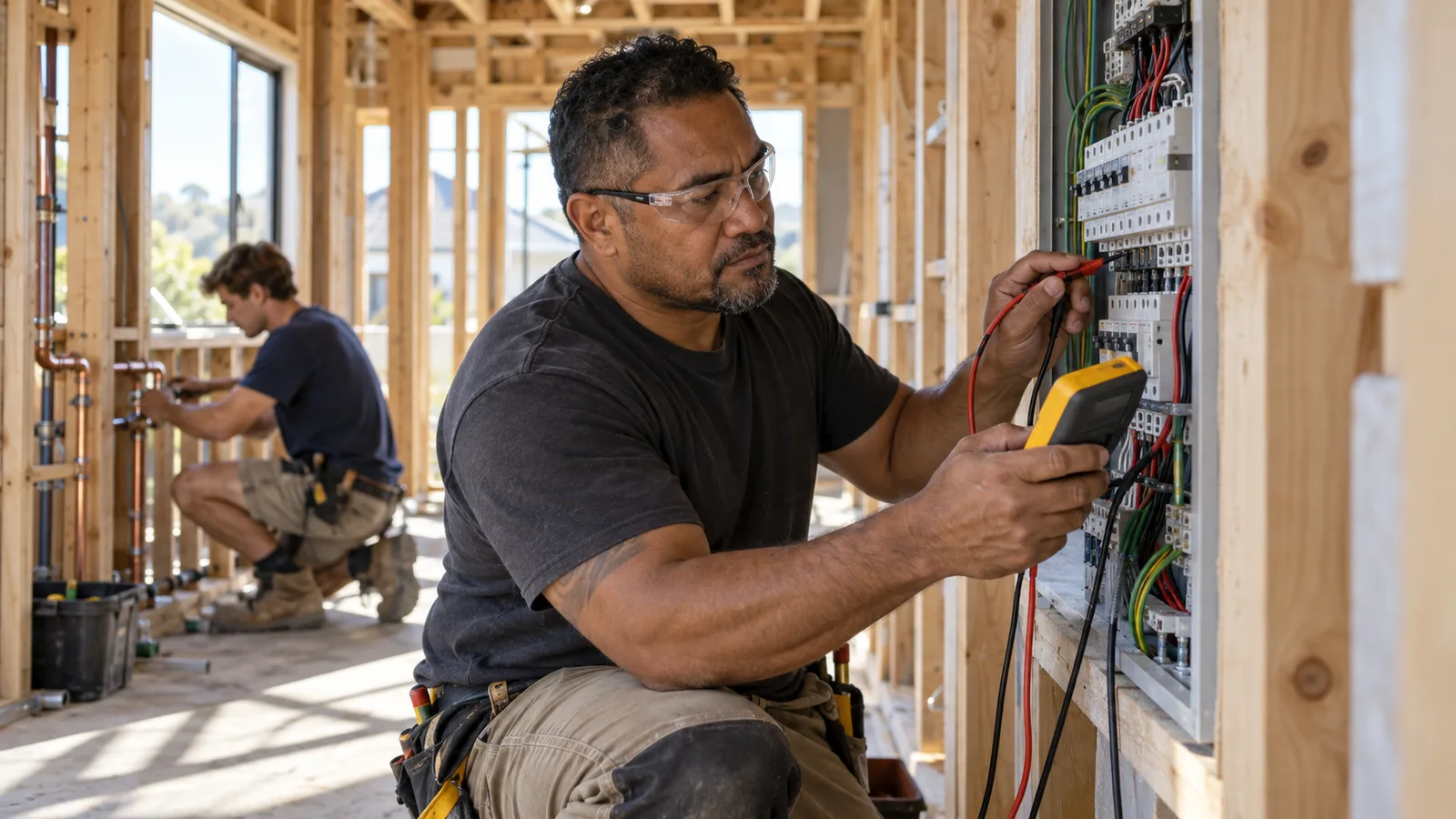
A trade licence in Australia is issued state by state, so what you need depends on where you plan to work. Trades Recognition Australia (TRA) says licence requirements vary between states and territories, that you may need a Certificate III for a full licence, and that a licence does not always let you work as a contractor. Your qualification matters, but it is one step towards a licence, not the licence itself.
Who issues a trade licence in Australia?
No single office licenses tradespeople for the whole country. TRA's advice is to confirm the requirements and conditions of each licence category with the licensing authority in the state or territory where you want to work.
Electrical work shows how much the names change at each border. The table lists the bodies TRA names on its page for overseas electricians, and what an overseas-trained electrician holding an Offshore Technical Skills Record (OTSR) applies for first.
| State | Body named by TRA | First document for an overseas electrician with an OTSR |
|---|---|---|
| NSW | Building Commission NSW | Provisional Tradesperson Certificate |
| Victoria | Energy Safe Victoria | Supervised Workers Licence |
| Queensland | Electrical Safety Office | Electrical work training permit |
| Western Australia | Department of Local Government, Industry Regulation and Safety (LGIRS) | Electrical Workers Permit |
| South Australia | Consumer and Business Services | Restricted Electrical Worker Registration |
Five states, five different documents for the same stage of the same trade. If you move interstate, ask the new regulator what applies to you.
Which trades need a licence?
TRA describes four trades as licensed occupations: Electrician (General), Electrician (Special Class), Plumber (General) and Air-conditioning and Refrigeration Mechanic.
NSW shows how strict the rule can be. There you need an electrical licence or certificate before doing any electrical wiring work, whatever the cost or type of job. Unlicensed electrical work in NSW can bring fines of $22,000 for an individual or $110,000 for a company.
Construction trades are less uniform. TRA tells construction trade applicants that some states and territories require a licence or registration for construction occupations, and that they should check with the relevant state or territory department before applying for a skills assessment.
So if you are a carpenter, bricklayer or tiler, ask the question for the state you are heading to. When you reach the skills assessment, our checklist of evidence for a TRA skills assessment covers the paperwork.
The Certificate III behind a full licence
TRA says you may need a Certificate III Australian vocational qualification for a full licence. On the Australian Qualifications Framework, a Certificate III sits at level 3 and qualifies people to undertake skilled work.
NSW sets out one pathway to an electrical licence in three parts: a completed Certificate III in Electrotechnology Electrician (UEE30820, or an earlier version), a certificate of proficiency from the Vocational Training Review Panel of NSW, and at least 12 months of relevant electrical wiring work experience. The qualification is one of three requirements, not the whole list.
Plumbing works the same way. For overseas-trained plumbers, each state and territory plumbing licensing board sets the pathway to the Certificate III in Plumbing and a full licence, and TRA says cost and time differ by state.
Where recognition of prior learning fits
Recognition of prior learning (RPL) recognises skills you gained through previous training, work or life experience. A Registered Training Organisation (RTO) has a qualified assessor compare your skills and knowledge with the course requirements. You might receive full or partial credit, and where your evidence falls short the provider may offer additional training.
Licensed trades come with a caution. The Australian Skills Quality Authority (ASQA) says a training provider must give you the opportunity to apply for RPL unless course rules or licensing requirements prevent it. Building Commission NSW advises checking the National Training Register at training.gov.au and confirming availability with an RTO before you start training or RPL for a licence qualification.
Ask two questions before you commit. Is RPL available for this qualification? And is it the qualification the regulator in my state asks for? ASQA says providers must clearly tell you the course title, code and currency, and any licensing or occupational licence requirements.
Our guide to each stage of the RPL process in Australia walks through the assessment itself.
Tradesperson licence or contractor licence?
A licence to do the work is not automatically a licence to contract for it. TRA says a licence does not always allow you to become a contractor, because contractor licences generally need further training and experience.
NSW adds a point for people who trained abroad. It does not recognise qualifications from outside Australia for contractor licences or certificates. Overseas-trained electricians and plumbers can get an OTSR, but they must also complete Australian context gap training and supervised employment.
How long a licence lasts differs too. In NSW, a provisional tradesperson certificate is issued for 3 years and cannot be renewed, while other NSW electrical licence types can be issued for 1, 3 or 5 years.
If your goal is to work for yourself, ask the regulator early what a contractor licence needs in that state, so the extra training and experience are in your plan from the start.
Trained overseas? Five steps from skills record to licence
For electricians, plumbers and air-conditioning and refrigeration mechanics, TRA sets out the route in order. It starts with the OTSR, which you receive when you complete a skills assessment through a TRA-approved RTO. The OTSR records the technical skills you demonstrated against the relevant Australian qualification.
- Get an OTSR. For permanent migration in these trades, TRA's Offshore Skills Assessment Program is compulsory. Our guide to the TRA skills assessment programs explains which program fits your case.
- Apply for a provisional licence. A state or territory regulator issues it so that you can work under supervision.
- Complete Australian context gap training. For electricians, TRA names 11297NAT Course in Electrician - Minimum Australian Context Gap as the gap training in the ACT, NSW, the NT, South Australia and Victoria.
- Get the Australian qualification. In NSW, for example, a plumber completes gap training with an RTO to be issued a Certificate III in Plumbing.
- Apply for the occupational licence. Some states add their own tests. In Victoria, an electrician must also complete the Licensed Electricians Theory (LET) and Licensed Electricians Practical (LEP) assessments before a full licence.
The supervised stage runs on a clock, and the clock is set by each state:
- Electricians: TRA requires supervision by a fully licensed electrician for at least 12 months in the ACT, NSW, the NT, Tasmania and Victoria. Queensland's electrical work training permits are for 12 months.
- Plumbers in Queensland, Tasmania and Western Australia: a provisional licence may be issued for 12 months, working under the supervision of a licensed plumber.
- Plumbers in NSW: the Provisional Tradesperson Certificate runs for three years and cannot be renewed.
TRA says there is no nationally agreed gap training package for migrant plumbers who hold an OTSR. In Queensland, overseas applicants for a QBCC licence must meet all the usual eligibility requirements and hold a visa or ImmiCard entitling them to work in Australia.
The white card: for every worker on a construction site
A white card is not a trade licence, but you cannot start on site without one. Safe Work Australia says workers must have a construction induction card, known as a white card, before they can start working on a construction site. You must show it to the PCBU on site and to inspectors who ask.
To get one, a worker must do the training course "Prepare to work safely in the construction industry". White cards are recognised Australia-wide, unlike most of what this guide covers.
SafeWork NSW adds two details for that state. You first complete general construction induction training with an RTO, which gives you a statement valid for 60 days as proof until your card arrives. And a white card becomes void if you have not carried out construction work for two consecutive years or more, so check yours before returning to site after a long break.
Common mistakes with trade licences
- Treating a skills assessment as a licence. TRA says it does not award Australian qualifications, occupational registrations or occupational licences. A positive assessment supports a visa application; it is not permission to pick up the tools.
- Carrying one state's rules into another. The regulator, the name of the permit and the length of the supervised period all change.
- Treating the OTSR as the qualification. In TRA's steps, gap training and the Australian qualification come after the OTSR.
- Starting RPL before checking the licence side. Confirm that RPL is available for the qualification and that the regulator asks for that qualification.
- Letting a provisional certificate run down. In NSW it lasts 3 years and cannot be renewed, so plan gap training and supervised work inside that window.
- Trusting shortcut marketing. ASQA warns about phrases such as "no study or exams required" and "receive your qualification in 7 days", and says it can cancel a qualification issued without proper training and assessment.
Frequently asked questions
Is a trade licence in Australia the same in every state?
No. TRA says licence requirements vary depending on the state or territory you want to work in. Confirm the requirements and conditions of each licence category with the licensing authority in that state or territory before you make plans.
Does a Certificate III give me a trade licence?
Not by itself. TRA says you may need a Certificate III for a full licence, but the licence is a separate application to a state or territory regulator. One NSW electrical pathway, for example, also asks for a certificate of proficiency and at least 12 months of relevant electrical wiring work experience.
Can I work as a contractor once I hold a trade licence?
Not always. TRA says a licence does not always allow you to become a contractor, because contractor licences generally need further training and experience. Ask your state or territory regulator what the contractor licence needs on top of the one you hold.
Do I need a white card if I already hold a trade licence?
If you work on a construction site, yes. Safe Work Australia says workers must have a white card before they can start work on a construction site, and must show it to the PCBU on site and to inspectors who ask.
Can I use RPL for a qualification that leads to a licence?
Sometimes, so ask first. ASQA says a training provider must give you the opportunity to apply for RPL unless course rules or licensing requirements prevent it. Building Commission NSW advises checking training.gov.au and confirming availability with an RTO before you start training or RPL for a licence qualification.
Key takeaways
- A trade licence in Australia comes from a state or territory regulator, and the requirements vary between them.
- You may need a Certificate III for a full licence, but the qualification is one requirement among several.
- A tradesperson licence does not always let you contract; contractor licences generally need further training and experience.
- Overseas-trained electricians and plumbers move from an OTSR to a provisional licence, gap training, the qualification and then the licence.
- Every worker needs a white card before starting on a construction site, and it is recognised Australia-wide.